Refine by
Channel
Showing best results - all illustrated entries. Change the channel to view specific categories.
Smoke and fire detectors
(77)
Smoke and fire detectors. Find the best solution for your project here.
Smoke and fire detectors - helping you find the best solution for your project.
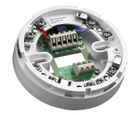 The Series 65 range of conventional detectors incorporates well-proven sensing technologies, together with advances in materials and electronics technology. The Series 65 auxiliary relay base provides two sets of volt-free changeover contacts to facilitate the switching of a remote LED or other auxiliary device. Features: Advanced electronic
- PRODUCT
- Apollo Fire Detectors
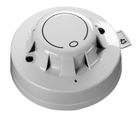 The Discovery carbon monoxide (CO) fire detector contains a long-life electrochemical CO sensor. The sensing technology is fast, accurate and needs only very low power. It does not detect smoke particles or heat and are is not a universal replacement for smoke detectors. CO fire detectors are electronic detectors that can indicate the outbreak of
- PRODUCT
- Apollo Fire Detectors
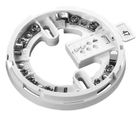 The Discovery intelligent mounting base requires only a low insertion force for installation, making it suitable for use on suspended ceilings. It has stainless steel contacts for the detector terminals and is supplied with an XPERT card. All detectors in the Discovery and XP95 ranges fit into the intelligent mounting base
- PRODUCT
- Apollo Fire Detectors
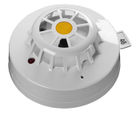 The XP95 heat detector has a low air-flow resistant case for good contact between the sensing thermistor and the surrounding air. Temperature is measured by a single thermistor network which gives a voltage output proportional to the external air temperature. The signal is processed and transmitted to the control equipment
- PRODUCT
- Apollo Fire Detectors
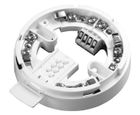 The Discovery intelligent heater base is designed to be used in cold climates where environmental conditions could result in either icing or condensation affecting the operation of detectors
- PRODUCT
- Apollo Fire Detectors
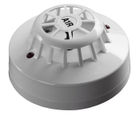 AlarmSense is a range of conventional detection and alarm products specially designed to be connected to the same pair of supply wires. The AlarmSense heat detector operates by using a matched pair of thermistors to sense heat. One thermistor is exposed to the ambient temperature, the other is sealed. In normal conditions, the two thermistors
- PRODUCT
- Apollo Fire Detectors
 AlarmSense is a range of conventional detection and alarm products specially designed to be connected to the same pair of supply wires. AlarmSense mounting bases are specifically designed for the mounting of AlarmSense detectors. They are fitted with electronic circuitry to monitor the presence of detectors and allow a fault to be signalled if a
- PRODUCT
- Apollo Fire Detectors
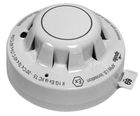 The XP95 ionisation smoke detector uses irradiated air in the dual sensing chambers to produce ions that travel to the positive and negative electrodes, creating a current flow. As smoke enters the outer chamber, the flow drops and voltage increases. The voltage is measured and an analogue signal is converted to digital for transmission to the
- PRODUCT
- Apollo Fire Detectors
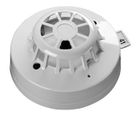 The Discovery heat detector, distinguishable by a low airflow resistant case, uses a single thermistor to sense the air temperature around the detector. The thermistor is connected in a resistor network, which produces a voltage output dependent on temperature
- PRODUCT
- Apollo Fire Detectors
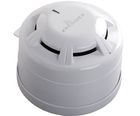 XPander is a wireless intelligent detector range in which individual alarm devices communicate with the XP95 loop by radio signals. Every device is assigned an address and this address is recognised by the control panel in the same way as is the address of any device connected directly to the loop wiring. The XPander optical smoke detector works
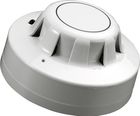 The Series 65 range of conventional detectors incorporates well-proven sensing technologies, together with advances in materials and electronics technology. The ionisation smoke detector irradiates air in the dual sensing chambers to produce ions that travel to the positive and negative electrodes, creating a current flow. As smoke enters the
- PRODUCT
- Apollo Fire Detectors
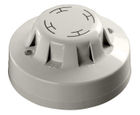 AlarmSense is a range of conventional detection and alarm products specially designed to be connected to the same pair of supply wires. The integrating optical smoke detector uses an internal pulsing LED and a photodiode at an obtuse angle. In the event of smoke entering the chamber, the light pulse from the LED will be scattered and registered by
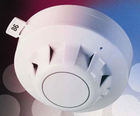 The XP95 optical detector uses an internal pulsing LED and a photo-diode at an obtuse angle. In the event of smoke entering the chamber, the light pulse from the LED will be scattered and registered by the photo-diode. A signal is generated and transmitted digitally to the control equipment
- PRODUCT
- Apollo Fire Detectors
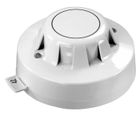 The Discovery optical smoke detector uses an IR LED that pulses light across a smoke chamber with a photodiode set at an obtuse angle. In clear air it receives no light, but when smoke enters the chamber, light from the LED is scattered onto the photodiode. A signal is then processed to provide an analogue value for transmission when the detector
- PRODUCT
- Apollo Fire Detectors
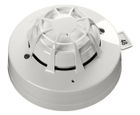 The XP95 multisensor detector contains an optical smoke sensor and a thermistor temperature sensor whose outputs are combined to give the final analogue value
- PRODUCT
- Apollo Fire Detectors
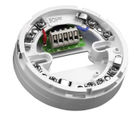 The Series 65 range of conventional detectors incorporates well-proven sensing technologies, together with advances in materials and electronics technology. The Series 65 standard relay base provides one set of volt-free changeover (from C) contacts that change state when the detector signals an alarm. Features: Advanced electronic technology
- PRODUCT
- Apollo Fire Detectors
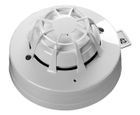 The Discovery multisensor detector contains an optical smoke sensor and a thermistor temperature sensor whose outputs are combined to give the final analogue value. The multisensor is useful over a wide range of applications and is highly immune to false alarm sources
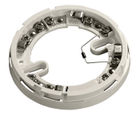 The Series 65 range of conventional detectors incorporates well-proven sensing technologies, together with advances in materials and electronics technology. The Series 65 diode base is designed for use with conventional systems that have manual call points and detector bases on the same circuit. The base is fitted with a schottky diode on both the
- PRODUCT
- Apollo Fire Detectors
 The Series 65 range of conventional detectors incorporates well-proven sensing technologies, together with advances in materials and electronics technology. The Series 65 end-of-line (EOL) relay base is intended for use with four-wire circuits. It features two sets of changeover contacts and a power supervision relay. Features: Advanced electronic
- PRODUCT
- Apollo Fire Detectors
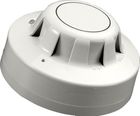 The Series 65 range of conventional detectors incorporates well-proven sensing technologies, together with advances in materials and electronics technology. The optical smoke detector uses an internal pulsing LED and a photodiode at an obtuse angle. In the event of smoke entering the chamber, the light pulse from the LED will be scattered and
- PRODUCT
- Apollo Fire Detectors
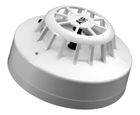 The Series 65 range of conventional detectors incorporates well-proven sensing technologies, together with advances in materials and electronics technology. The A1R heat detector operates by using a matched pair of thermistors to sense heat. One thermistor is exposed to the ambient temperature, the other is sealed. In normal conditions, the two
- PRODUCT
- Apollo Fire Detectors
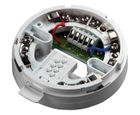 The Discovery isolating base senses and detects short-circuit faults on Discovery and XP95 loops and spurs
- PRODUCT
- Apollo Fire Detectors
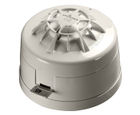 XPander is a wireless intelligent detector range in which individual alarm devices communicate with the XP95 loop by radio signals. Every device is assigned an address and this address is recognised by the control panel in the same way as is the address of any device connected directly to the loop wiring. The XPander rate-of-rise heat detector
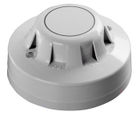 AlarmSense is a range of conventional detection and alarm products specially designed to be connected to the same pair of supply wires. The optical smoke detector uses an internal pulsing LED and a photodiode at an obtuse angle. In the event of smoke entering the chamber, the light pulse from the LED will be scattered and registered by the
- PRODUCT
- Apollo Fire Detectors