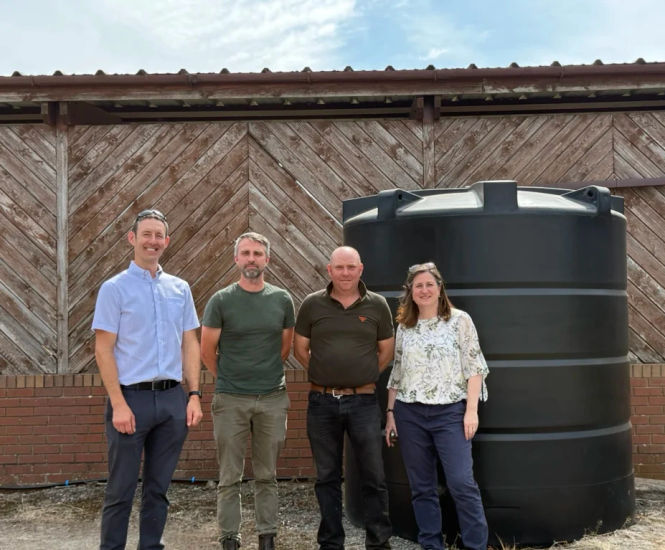

Last month, SDS had the pleasure of welcoming Dr Julia Buckley, Member of Parliament for Shrewsbury, on a visit to several Shropshire sites where it has delivered innovative smart water management solutions as part of the River Severn Partnership Advanced Wireless Innovation Region (RSPAWIR) programme.
The visit provided an opportunity to demonstrate the role that emerging water technologies can play in shaping the future of sustainable water management. As a leading member of the All-Party Parliamentary Group (APPG) for Water, Dr Buckley plays an important role in supporting discussions around future water policy and advising on the challenges and opportunities facing the UK’s water sector. She is actively advocating for parliamentary legislation to mandate rainwater and greywater reuse, and is pushing for increased developer responsibilities for sustainable drainage in new housing developments. Her visit offered valuable insight into how innovative, technology-led solutions are being deployed in real-world settings to address growing pressures on water resources, climate resilience and flood management.
The visit showcased how intelligent rainwater harvesting and management technology is helping farms, sports facilities and community organisations become more resilient to climate change by tackling two growing challenges simultaneously: drought and flooding.
The first stop was Caynton Farm, a mixed-use agricultural holding where SDS has installed its Intellistorm® smart rainwater harvesting and management system to improve water self-sufficiency while reducing runoff into the River Strine catchment.
The installation provides 15,000 litres of intelligent rainwater storage through a network of connected tanks that work together using SDS’s SYMBiotIC™ wireless platform. The system automatically monitors water levels, irrigation demand and local weather forecasts, ensuring rainwater is prioritised for livestock, equipment washing and general farm operations during dry periods. Before heavy rainfall, the system intelligently releases water to create additional storage capacity, helping reduce flood risk downstream.
The project has significantly reduced the farm’s reliance on borehole water while providing a fully automated solution that requires minimal intervention, demonstrating how precision water management can improve agricultural sustainability and climate resilience.
The second visit took the group to Aqualate Golf Centre near Newport, where SDS has delivered an intelligent rainwater management system designed to enhance irrigation, improve flood resilience and support the golf centre’s ambitious environmental objectives.
Six Intellistorm® smart rainwater harvesting tanks capture runoff from the clubhouse and maintenance buildings. Four of these tanks feed a purpose-built irrigation pond used to water the course, while the remaining two provide harvested rainwater for compost-tea production as part of the club’s chemical-free turf management programme.
Using predictive weather forecasting, the system automatically creates additional storage ahead of storms, reducing surface water runoff into the River Strine while ensuring sufficient water is available to maintain the greens and fairways during increasingly dry summers. The project highlights how intelligent water management can deliver both environmental and operational benefits for community sports facilities.
The final stop was Newport Salop Rugby Union Football Club, where SDS has installed one of its most advanced rainwater harvesting systems to support the long-term sustainability of the club’s playing surfaces.
The installation combines a 20,000-litre primary storage tank with eight additional 720-litre tanks, creating a large-scale irrigation system capable of capturing rainfall from the club’s complex multi-section clubhouse roof. Rather than requiring extensive civil engineering works, SDS developed an innovative solution that intercepts water from every downpipe and transfers it into the central storage system using strategically positioned forwarding pumps.
Powered by Intellistorm®, the system continuously monitors and manages storage levels using local weather forecasts, automatically balancing the need to retain water for irrigation while creating capacity before significant rainfall events. The result is a sustainable source of irrigation water that reduces reliance on mains and borehole supplies, improves the quality and resilience of the grass playing surfaces, and contributes to reducing pressure on the River Strine catchment during heavy rainfall.
Speaking following the visit, Dr Buckley said: “The work that SDS have undertaken on the sites in Shropshire show how intelligent rainwater management can be deployed to bring benefits during both drought and deluge. This type of installation helps make every drop matter, ensuring that we are only using potable water when essential, reducing the impact on our natural resources, and helping to manage flooding.”
Dr Sewell added that the projects demonstrate how innovative technology can provide practical, real-world solutions to some of the biggest environmental challenges facing both urban and rural communities:
“These installations show that smart water management is no longer just about harvesting rainwater. By combining intelligent controls, weather forecasting and wireless monitoring, we’re helping organisations make the very best use of every drop of water while also reducing flood risk downstream.
It was a pleasure to welcome Dr Julia Buckley MP and showcase how these projects are delivering measurable environmental, operational and community benefits across Shropshire. As a member of the Water APPG, Dr Buckley’s interest in seeing these solutions first-hand reflects the importance of connecting policy discussions with practical innovation taking place on the ground.”
The visit highlighted the success of the RSPAWIR programme in bringing together innovation, local authorities and industry to deliver smarter, more sustainable infrastructure. It also demonstrated how practical examples of technology deployment can help inform wider discussions around future water policy, strengthening resilience to climate change while protecting valuable water resources for future generations.